Audio to Text Transcription that turns recordings into accurate text

Convert audio to text online, then export clean, readable transcripts.

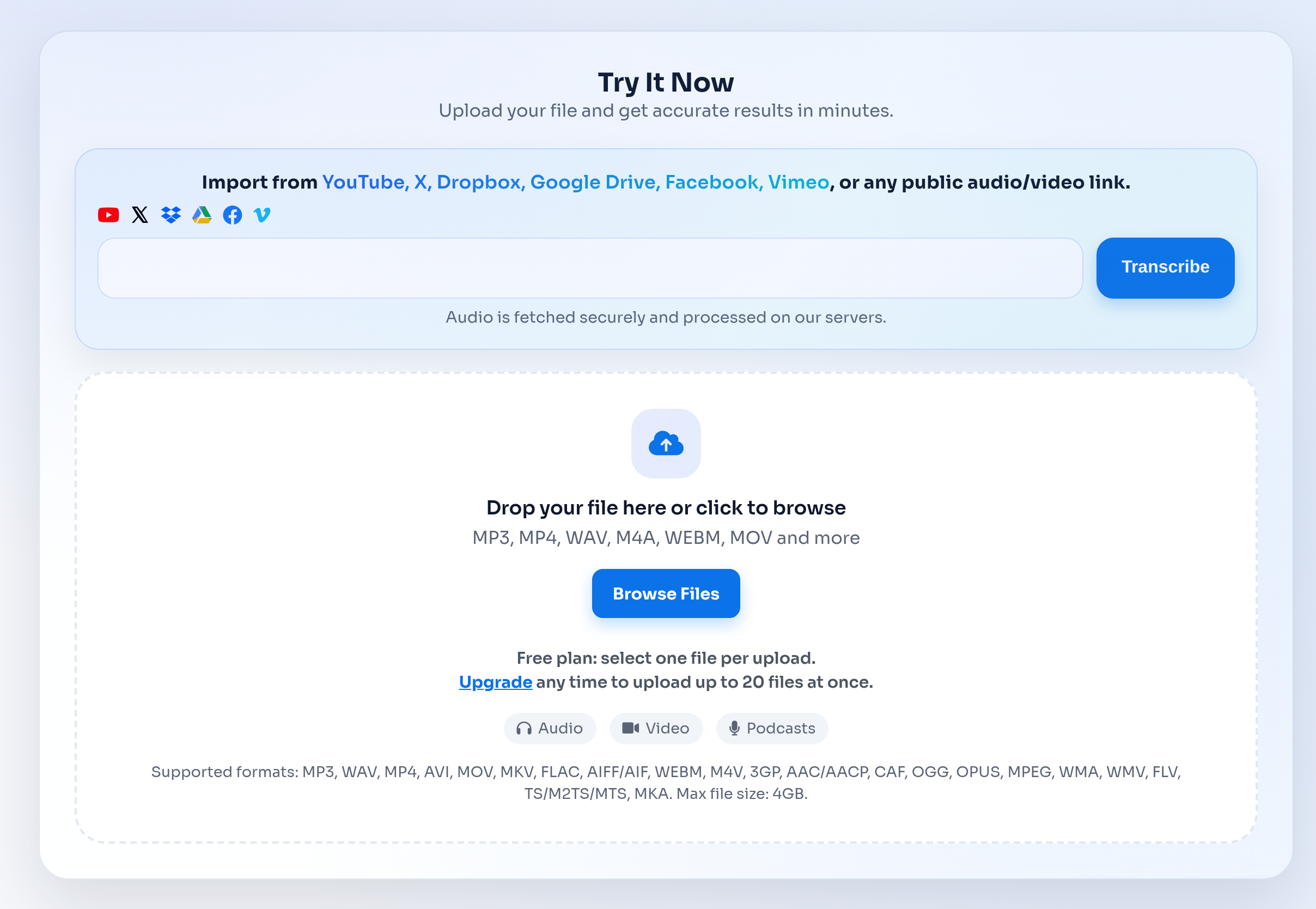
Try It Now

Upload your file and get accurate results in minutes.

Import from YouTube, X, Dropbox, Google Drive, Facebook, Vimeo, or any public audio/video link.
Audio is fetched securely and processed on our servers.

Drop your file here or click to browse

MP3, MP4, WAV, M4A, WEBM, MOV and more

Free plan: select one file per upload.
Upgrade any time to upload up to 20 files at once.
Audio Video Podcasts

Supported formats: MP3, WAV, MP4, AVI, MOV, MKV, FLAC, AIFF/AIF, WEBM, M4V, 3GP, AAC/AACP, CAF, OGG, OPUS, MPEG, WMA, WMV, FLV, TS/M2TS/MTS, MKA. Max file size: 4GB.

Uploading... 0%
You can now leave or close this page. Your transcript will be available in the history section.
Uploading Your File
0 MB/s
Upload Speed
0 MB
Uploaded
0 MB
Total Size
--
Time Left
Preparing upload...
0 Processing Time
0 Text Segments

About Audio to Text Transcription

Audio to text transcription converts a recorded audio file into written text you can search, edit, translate, and share.

TranscribeText works with uploaded files, so you can transcribe meetings, interviews, lectures, podcasts, voice notes, and video audio without typing anything by hand.

Generate accurate transcripts with punctuation and timestamps, then export TXT, DOCX, or SRT in minutes.

Built for this transcription workflow

Use this audio to text transcription page to convert MP3, WAV, M4A, and video files into accurate, editable text for meetings, interviews, lectures, podcasts, and research recordings.

Detailed guide

Practical details to help you choose the right transcription workflow before uploading a file.

What is audio to text transcription?

Audio to text transcription is the process of turning recorded speech into written text that is easy to search, edit, and reuse.

TranscribeText is designed for uploaded recordings rather than live dictation, so you can convert saved audio and video files into clean transcripts.

  • Upload a recorded audio or video file from your device.
  • Receive readable text with punctuation, timestamps, and speaker labels when available.
  • Export the transcript for notes, captions, subtitles, or translation.

Which audio and video formats can you transcribe?

The converter accepts the most common audio and video formats, so you do not need to convert files before transcription.

Supported uploads include MP3, WAV, M4A, MP4, FLAC, OGG, WebM, and MOV recordings.

  • MP3 and WAV are ideal for podcasts, calls, and interviews.
  • M4A is common for iPhone voice memos and mobile recordings.
  • MP4, MOV, and WebM work when you also need subtitles for video.

Free audio to text transcription and when to upgrade

You can start transcribing for free to test accuracy and the export formats before choosing a paid plan.

Upgrade when you need longer recordings, more daily uploads, or batch transcription for regular work.

  • Free users can upload up to 3 files per day.
  • Free files have a 30-minute duration limit per file.
  • Unlimited plans support longer recordings and heavier transcription work.

How to get an accurate transcript

Transcription accuracy depends mostly on the recording quality rather than the file format.

Clear speech, steady volume, and low background noise usually produce the most accurate text.

  • Record close to the speaker and reduce echo when possible.
  • Avoid overlapping speakers and background music.
  • Upload the original high-quality file instead of a compressed copy.

Common ways people use Audio to Text Transcription

Specific workflows for teams, creators, researchers, educators, and operations users.

Meeting and interview transcription

Turn meetings, interviews, and calls into searchable notes with decisions and action items.

Lecture and course transcription

Convert lectures, seminars, and online courses into study notes you can search later.

Podcast and video transcription

Create show notes, articles, captions, and subtitles from podcasts and video content.

How the workflow works

From upload to transcript export without manual copy-paste cleanup.

Upload your audio or video file

Add MP3, WAV, M4A, MP4, MOV, WebM, or another supported format directly from your browser.

Convert audio to text with AI

TranscribeText transcribes the recording and returns readable text with punctuation and timestamps.

Export the format you need

Download TXT for plain text, DOCX for editing, or SRT for subtitles and captions.

Upload limits and export formats

Audio to text searches often compare free limits, supported formats, and export options before uploading.

Max upload size

Up to 4 GB per file.

Free allowance

Free users can upload up to 3 files per day, with a 30-minute duration limit per file.

Paid workflow

Unlimited plans support longer files and batch uploads for heavier transcription work.

Available export formats

TXT SRT DOCX Timed TXT Speaker TXT
TranscribeText product workflow preview showing file upload and transcription features

A real file-to-transcript workflow

The audio to text transcription workflow supports quick single files as well as repeat transcript exports from your dashboard.

  • Upload audio or video files directly from your browser.
  • Review clean transcript text with timestamps and speaker options.
  • Export TXT, SRT, DOCX, and timed text outputs when the job is complete.

Privacy handling for uploaded recordings

Transcription often involves client calls, internal meetings, interviews, or class material. These pages should make the handling model clear before users upload.

  • Uploaded media is processed to generate transcripts and downloadable output files.
  • Uploaded media is automatically deleted from the processing environment shortly after transcripts are generated.
  • Transcript outputs remain available in the user dashboard until the user deletes them or requests removal.
  • TranscribeText applies encryption in transit and at rest, segregated processing queues, and restricted production access.

Audio to text transcription comparison

Use TranscribeText when you want a browser-based upload workflow with accurate transcripts and simple export files.

Feature TranscribeText Typical alternatives
Recorded file uploads Upload MP3, MP4, M4A, WAV, MOV, WebM, and other common audio/video files. Some tools focus on live meeting capture or require a platform-specific workflow.
Export formats TXT, SRT, DOCX, timed TXT, and speaker-labeled outputs when available. Export options vary by provider and plan.
Async review Start a transcription job, leave the page, and return to history when the transcript is ready. Manual workflows often require waiting, copying, and reformatting.
Languages Transcribe in many languages and translate transcripts into 100+ languages. Language and translation coverage varies by provider.
Search intent match Best when you want to convert an existing audio or video file into editable text. Dictation tools focus on live voice input rather than recorded files.

Frequently Asked Questions

Everything you need to know about Audio to Text Transcription that turns recordings into accurate text.

How do I convert audio to text?

Upload your audio or video file, let TranscribeText generate the transcript, then export it as TXT, DOCX, or SRT.

Is audio to text transcription free?

Yes. Free users can transcribe up to 3 files per day, with a 30-minute duration limit per file, and upgrade for longer recordings.

Which audio formats can I transcribe?

You can upload MP3, WAV, M4A, FLAC, OGG, MP4, MOV, WebM, and many other common audio or video formats.

Can I translate the transcript into another language?

Yes. After transcription you can translate the text into more than 100 languages and export the translated transcript.

How large can my audio file be?

TranscribeText supports uploads up to 4 GB. Free users can upload up to 3 files per day with a 30-minute duration limit per file.

Is my uploaded audio deleted?

Uploaded media is automatically deleted from the processing environment shortly after transcripts are generated. Transcript outputs remain in your account until you delete them or request removal.

Do I need to install software?

No. TranscribeText runs in the browser, so you can upload files and download transcripts without installing desktop software.

Related Use Cases

Explore other transcription workflows that pair well with Audio to Text Transcription that turns recordings into accurate text.